
A Ray Of Hope
If you’re thinking of working with me, you might want to know who I am, what matters to me.
For as long as I can remember, I was told I was too sensitive, I talked too much and that I took things too personally. I took this to mean that being me was not okay, so I got really good at listening and paying attention to how others wanted me to be.
Then in my early forties my world fell apart. The death of my mum, separation, then divorce, then remarrying and navigating how to bring a blended family of five children together combined with becoming self-employed meant I was struggling. But I felt the need to look and sound okay for the benefit of others, even though inside I felt anything but.
Despite training to listen to others and becoming a coach in 2006, I had no idea how to talk about what I needed or how to name or process my thoughts or feelings. I was worried if I confessed to how I really felt that others would lose confidence in me. .
One day I was so exhausted, I gave my teen daughter an ultimatum and at just 16 she walked out of the door and never came back. I was heart broken, I felt a failure at home and a fraud at work. As I lay crumpled on the bedroom floor sobbing in the arms of my husband, I recall telling him that I could not do this anymore and that I just wanted to die.
As I rambled on I asked him, “How come I can help all my clients but I cannot help my own daughter?” To which he responded “What would you tell your clients to do? And that was the moment a ray of hope emerged and I knew I would be okay.
That day I started to attend my own programmes and take my own advice. Ironically for years I had been helping clients map out their own process in order to listen to and take their own advice but I had forgotten what I had known all along because my attention was outside on what others wanted and I failed to listen to myself.

What I have learned
Steven Covey, the author of “7 Habits of Effective People” said “To be heard and understood we have to first hear and understand” He was suggesting that we have to listen first, if we want others to listen to us, and I agree with this in principle. But here is the bind.
Listeners also need to be listened to, and it is rarely resourceful for us to listen when we ourselves are desperate to be heard.
When my world fell apart I was coaching for 8 hours a day, which meant I was listening and holding back my opinions, reactions and suggestions for that whole time. Then I would finish work and ask my family what they wanted for dinner, how their day was and because I know the value of listening, I would do my best to hold back my opinions, thoughts and suggestions.
But at times it felt like I had no time and space to actually say what I was thinking, inevitably I would vent or download to my husband. Although I had the the skill, time and desire to listen, I sometimes lacked the capacity.
But 2 hours coaching per fortnight was enough to give me the capacity to do both better whilst also learning about myself. Over time I recognise that I needed to increase my network of people that I felt able to talk to and who had the desire, skill, time and capacity to listen to me.
That feeling of not being able to get yourself heard and understood is probably one of the most frustrating feelings, I have ever experienced and whilst it can still happen, I now have strategies to set my listener up for success.
Making Space for You In Your Life
As a professional listener I have a supervisor, I talk to on a regular basis to process and make sense of what I hear and how to best support my clients. In business I have a PA to talk to about the workload and priorities and I can delegate tasks that I don’t have time, capacity, skill or desire to do. But in my personal world I had limited myself to only really talking to my husband when I was struggling.
Despite being trained as a coach I had I failed to identify when I needed a coach or that the problem was that I lacked clarity of what I wanted and was mostly focused on what I did not want.
I had spent so much of my life trying to hide how I felt, it took the kindness and patience of a compassionate listener for me to really hear what I think, believe, want and need to be at my best and what helps me get back from being at my worst.
But I was the lucky. I did know about coaching and I knew it worked, I had just forgotten in the busyness of life. Now I take time out regularly to talk to listen to myself. Sometimes I can take time to journal and that is enough, other times I can talk to friends or family but now I know when I need someone outside of my system to help me make sense of what is happening and what I would like to have happen instead.


Your Passport To Better Conversations
Knowing what you want and need is one thing, but having the skills and confidence to advocate for them is another.
I soon learned that as a coach I have a contract and I have permission to ask questions but in every day life, not everyone enjoys being asked questions. Then there is the time and energy it takes to listen and how differently we all experience ‘feeling heard’. For some it is about being asked questions, but for others it is about being really quiet and looking interested. For some they feel heard when you share an experience similar to theirs but for others that feels like you are taking the focus from them to you.
Given that what makes us feel heard is different for different people and what worked yesterday may not work today, I recognised that the speaker had as much responsibility and the listener to set them up for success.
The speaker could benefit from understanding their purpose for talking and to have an idea of what they needed from their listener. Not to mention checking before they start talking the person has the desire, skill, time and capacity to listen.
By tracking what works for you, you can create a range of practical prompts that set you and your listener up for success.
Success Without Stress
Inspired by Karen Williams of Librotas, my client in 2009 and now good friend, collaboration partner and book mentor, I have been encouraged to write about my experiences, my journey and my processes. In doing so I have discovered yet another way of hearing and understanding myself and I love that it also inspires others to get to know like and trust their own process or borrow mine.
I have for almost fifteen years produced a stress management update called “Success without stress” and you can sign up here.
I wrote and published my first book, Manage Your Critic: From Overwhelm to Clarity in 7 Steps, in 2016, which focuses on the process that I learned when I trained as a coach working one to one. By mapping out how the kind of listening I was doing helped my clients transform overwhelm into clarity. Understanding my own process has proven to be a valuable resource that I still use today.
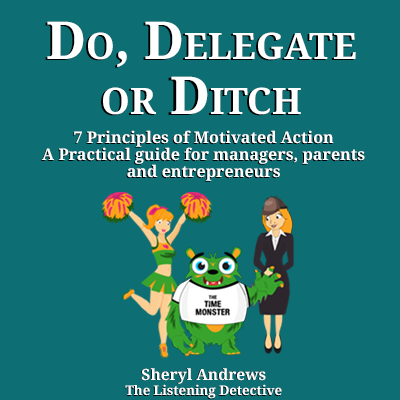
I am currently writing my soon-to-be-published second book ‘Do, Delegate or Ditch, Reclaim Agency One Decision at A Time.
This book talks more about metaphors, models and maps and how a few coaching questions can resource you to work, learn and live at your best with others.
I share what I believe the six core skills to be and how using those skills to model what you need to work, learn and live at your best can make sense of so many of the things that cause us frustration. I also share the five most common causes of frustration that I have heard over the years and so I will be sharing stories, strategies and coaching questions to help the reader reflect on things like:
• Train them to listen and you not to nag
• Your passport to better conversations
• The just do it myth
• The art of good decision making
• 7 principles of motivated action
Whether you are a parent, manager or entrepreneur, please know that you do not have to do it alone even when it feels like you are the only person that can action it.
If you are struggling to hear and understand or struggling to be heard and understood, let’s chat.
Even if I am not the right coach for you, I can help you clarify what kind of coach or support you need. Sometimes all you need to make it happen is clarity and confidence and having someone to share the process and celebrate progress with can often have a profound impact.